Styling · Style Journal 07 / 12
Formal Shirt and Trouser Combinations
Colour, contrast and texture — the principles that make a shirt and trouser look deliberate rather than accidental.
A shirt is rarely seen alone. It sits between the trouser below and the face above, and the success of an outfit depends far more on how those parts relate than on the merit of any single garment. The men who always look composed have not necessarily got better clothes; they have understood a handful of principles about contrast, colour and texture, and they apply them every morning without thinking.
Contrast: the first decision
Every combination begins with a question of contrast. A light shirt over dark trousers — white over charcoal, pale blue over navy — produces strong contrast, and strong contrast reads as formal, crisp and authoritative. It is the visual language of the boardroom and the interview room, and it is why the pairing has outlived every trend that has tried to replace it.
Low contrast is softer and more relaxed. A light blue shirt with stone or fawn trousers, or a mid-grey shirt with charcoal, creates a gentler, tonal look that suits creative workplaces, client lunches and the long middle of the week. Neither is better; they simply say different things. The mistake is to choose by accident, so that a man intending to look sharp ends up muted, or one hoping for ease looks stiff.
Consider your own colouring too. Men with deeper complexions and dark hair often carry high contrast effortlessly, and a bright white shirt near the face looks clean and vivid. Those with lighter or warmer complexions sometimes find that ivory, ecru or pale blue sits more kindly than optical white. The trouser can then supply the contrast lower down, where it frames the figure rather than the face.
Colour pairings that work
The formal palette is deliberately narrow, and that is its strength. Trousers in navy, charcoal, mid-grey, black, stone and olive cover almost every working situation, and each has a natural set of shirt partners. The table below is a starting point rather than a rulebook.
| Trouser | Strongest shirt partners | Effect |
|---|---|---|
| Charcoal | White, pale blue, lilac, pale pink | Formal, authoritative |
| Navy | White, sky blue, ecru, light grey | Polished, versatile |
| Mid-grey | White, blue, navy, soft burgundy | Balanced, modern |
| Stone or beige | Light blue, white, navy, olive | Relaxed, warm-weather |
| Olive | White, ecru, pale blue, rust | Smart-casual, textured |
| Black | White, pale grey, deep wine | Evening, sharp |
Notice what recurs: white and blue formal shirts appear in nearly every row. That is not a coincidence of taste but a fact of colour — white is neutral, and light blue sits harmoniously beside almost every trouser colour a man is likely to own. If a wardrobe is built around those two shirts, the trouser can change daily and the outfit will always hold together.
Black trousers deserve a note
Black is the trouser most men reach for first and use least well. In daylight, especially in an office, black trousers can look flat and severe beside a pale shirt. They come into their own in the evening, with a white or deep-toned shirt and polished black shoes. For the working week, charcoal does almost everything black does with more depth and less harshness.
Patterns and how to anchor them
Once a shirt carries pattern — stripes, checks, a fine micro-print — the trouser should almost always be plain. One pattern per outfit is the safe rule; two can work, but only when the scales are clearly different and the colours share a family, and that is better learned with experience than attempted on a Monday morning before a client meeting.
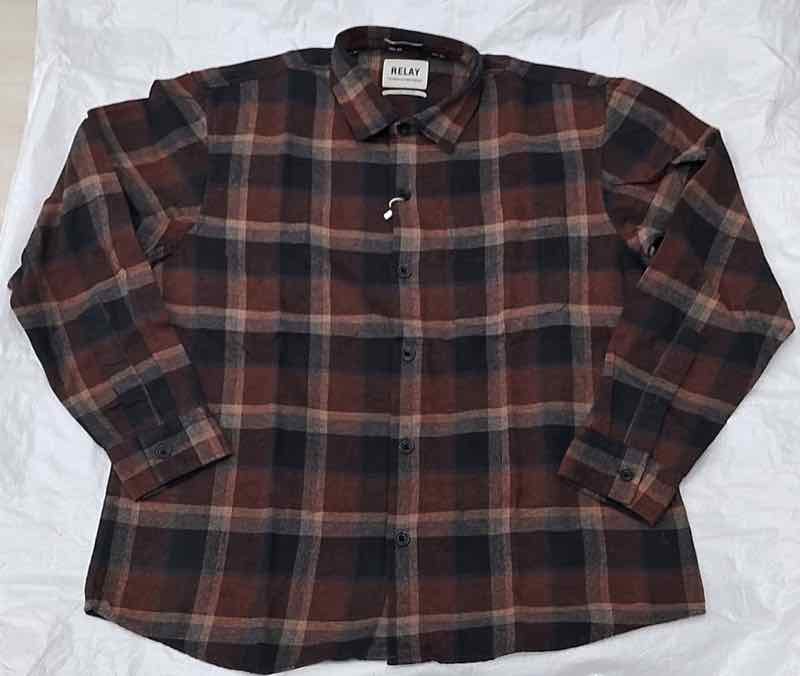
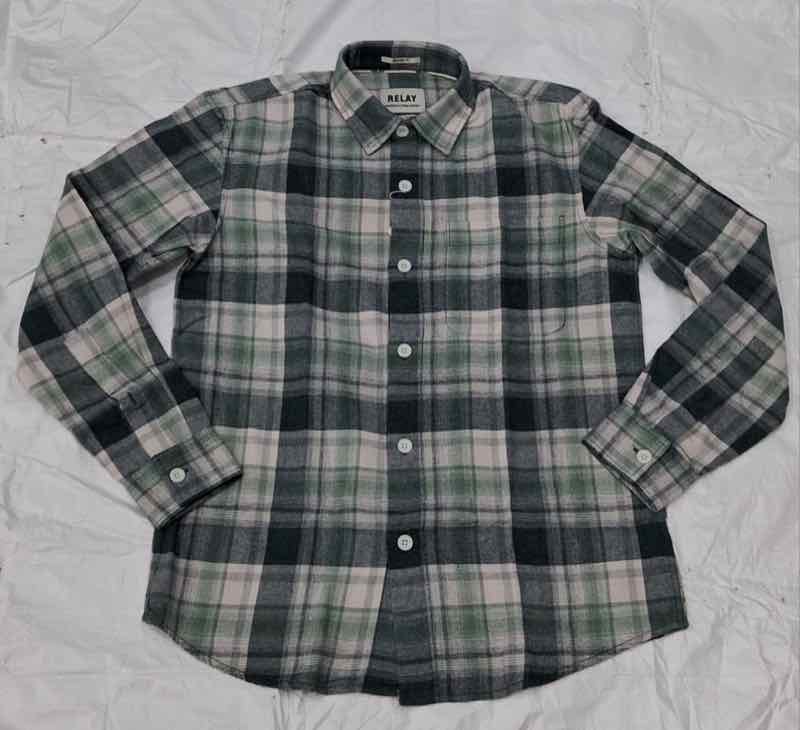
The most reliable technique with a patterned shirt is to take the trouser colour from the pattern itself. A maroon, navy and cream check, for instance, has three possible anchors. Navy trousers pick out the darkest line and give the most composed result; cream or stone trousers lift the lightest tone for a breezier, weekend feel; and a deep charcoal sits beneath the whole pattern without competing with any of it. A green, cream and black check works the same way — black or charcoal trousers ground it, while an ecru chino draws out the cream and makes the green feel fresh rather than heavy.
Take the trouser from the pattern, and the outfit looks designed rather than assembled.
Checks of this kind belong to the smarter end of casual dressing rather than to the strictly formal end, and that is worth acknowledging honestly. A multicoloured check is ideal for a Friday, a lunch, a travel day or an evening out; for an interview or a board presentation, a plain or finely striped shirt in white or blue remains the more considered choice. For a fuller view of how checks have moved into the working wardrobe, see our essay on the changing language of men's formal fashion.
Texture: the quiet third element
Colour and pattern are obvious; texture is subtle, and it is where well-dressed men gain their edge. A smooth poplin shirt looks sharpest against a smooth worsted trouser. An oxford or a slubby linen-blend shirt looks more at home beside cotton chinos or a trouser with a little visible weave. When the textures agree, the outfit feels coherent even if the colours are unremarkable.
Mismatched texture is a common reason an outfit looks slightly wrong without anyone being able to say why. A glossy, very fine shirt worn with rugged, washed-out cotton trousers can look like two separate outfits meeting in the middle. The fix is simply to keep the shirt and trouser at a similar level of refinement. Our guide to shirt fabrics and construction explains how the common weaves differ in surface and drape.
Belts, shoes and the rule of leather
Between shirt and trouser sits the belt, and below both sit the shoes. Together they are small in area but large in effect, because they frame the outfit at the waist and at the floor.
- Match belt to shoe. Black belt with black shoes, brown with brown. The shades need not be identical, but they should clearly belong to the same family.
- Keep formal belts slim. A narrow belt with a simple, polished buckle suits tucked formal shirts; wide, casual belts with heavy hardware belong with denim.
- Navy and grey trousers take both black and brown. Black is more formal; dark brown is warmer and more relaxed, and very handsome with navy.
- Charcoal and black trousers favour black shoes for business; dark brown works with charcoal in less formal settings.
- Stone, beige and olive trousers prefer brown — tan, chestnut or suede in the less formal end of the spectrum.
- Socks bridge trouser and shoe. Match socks to the trouser rather than the shirt, so that the leg reads as one continuous line when you sit.
Dressing the combination for Mumbai
A combination that works in an air-conditioned showroom must also survive the walk from the car, the local train or the auto-rickshaw. In Mumbai's heat and humidity, the weight of the trouser matters as much as its colour. Lightweight wool, fine cotton and cotton blends with good air permeability will keep their shape far better through a long day than heavy, tightly woven trousers that cling once the air turns sticky.
Colour has a practical role here too. Mid-tones such as navy, grey and olive forgive the creasing and the occasional splash of a monsoon street more gracefully than very pale trousers. Light stone or cream trousers look wonderful in the dry months, from November to February, but during the rains they are best kept for days spent indoors. On the shirt side, white and pale blue reflect heat and show less perspiration than mid-tones such as grey or bright colours, which can mark visibly under the arms and across the back.
Combinations to approach with care
Some pairings are not forbidden so much as difficult, and it helps to know where the difficulty lies.
- Shirt and trouser in the same mid-tone. A grey shirt with grey trousers of the same shade can look like a uniform. If you want a tonal look, separate the shades clearly — pale grey over charcoal, for example.
- Dark shirt, light trouser in a formal setting. A navy or black shirt over stone trousers inverts the expected order and reads as casual or evening wear rather than office wear.
- Two competing patterns. A bold check with a strong pinstripe trouser rarely resolves; one or the other should be plain.
- Bright colour over bright colour. A saturated shirt deserves a quiet trouser. Let one element speak.
- Untucked formal shirts. A shirt with a long, curved formal hem is designed to be tucked in. Shorter, straight-hemmed shirts are cut for wearing out.
Building many outfits from few pieces
The real reward of understanding combinations is economy. Four trousers — navy, charcoal, mid-grey and stone — paired with six shirts — two white, two light blue, one fine stripe and one smart check — give dozens of correct outfits without a single moment of doubt. Add one pair of black shoes, one pair of dark brown, and a matching belt for each, and the working wardrobe is effectively complete. The thinking behind this approach is explored in more depth in Building a Professional Shirt Wardrobe, and our formal shirt styling guide carries the principles into ties, layers and jackets.
Combinations are best judged in person, under natural light, with the trousers you actually wear. If you are looking for formal shirts in Mumbai that will work across your existing wardrobe, visit Options Mall in Juhu, Vile Parle West, to explore colours and patterns side by side and see how each one sits against the tones you already own.