
Construction · Style Journal 09 / 12
The Importance of Shirt Construction
Collars, yokes, plackets, seams and buttons — the quiet engineering that separates a good shirt from an ordinary one.
Two shirts can share the same colour, the same fabric and the same label size and still feel entirely different by the end of a day. The difference lies in construction: how the collar is built, how the yoke is cut, how the seams are sewn and how the buttons are attached. None of it is obvious on a hanger, and all of it becomes obvious after the twentieth wash.
Why construction matters more than it appears
Fabric is what you see first and feel first, so it naturally gets most of the attention. But a shirt is an engineered object as much as a textile one. It has to move with the shoulders, survive repeated washing and pressing, hold a collar upright for twelve hours and keep its buttons through years of fastening. Construction is what determines whether it does those things gracefully or badly.
Good construction is also the reason some shirts look better on the third year than on the first day. The fabric softens, the collar settles, the seams stay flat, and the shirt begins to sit as though it belongs to the wearer. Poorly made shirts tend to go the other way: seams pucker, collars bubble, the hem twists to one side and buttons start to hang by a thread. Learning to judge construction is therefore not an indulgence. It is the most practical skill a man can bring to choosing premium formal shirts.
The first day flatters every shirt. Construction decides how it looks on the hundredth.
The collar: structure you can feel
The collar is the most technically demanding part of a shirt and the most visible. It consists of an outer layer, an inner layer and, between them, an interlining that gives it body. How that interlining is applied matters a great deal.
Fused and sewn interlinings
A fused interlining is bonded to the collar fabric with heat. Done well, it produces a crisp, clean collar that holds its shape with little effort and suits a sharp business look. Done poorly, the bond can fail after repeated washing and hot pressing, and small bubbles or a rippled surface appear — a sure sign of cheap fusing. A sewn, or floating, interlining is stitched in rather than bonded. It gives a softer, more natural roll and tends to age gracefully, though it needs more careful ironing. Neither is automatically superior; what matters is that the collar is even, symmetrical and lies flat without puckering at the edges.
What to check
- The two collar points should be identical in length and shape.
- Edge stitching should run close to the edge, straight and even, with no wandering.
- Removable collar stays, where present, signal that the maker expects the collar to be pressed and cared for properly.
- The collar should meet the neckband cleanly, with the band sitting neatly at the back of the neck.
For more on the shapes collars take, see A Complete Guide to Shirt Collars.
Yoke, shoulders and the way a shirt hangs
The yoke is the panel across the upper back that joins the shoulders. It carries the weight of the whole shirt, and its cut determines how the shirt hangs from the body. A one-piece yoke is perfectly serviceable. A split yoke — two pieces joined at the centre back — allows the maker to angle each half to follow the slope of the shoulders more closely, and on a striped or checked shirt it creates a subtle chevron at the centre. It is a detail traditionally associated with careful shirtmaking.
Below the yoke, look for pleats. Box pleats at the centre back or side pleats near the shoulder blades give room for the arms to reach forward — useful when driving, writing or carrying a laptop bag — while darts at the lower back take in shape for a slimmer silhouette. A good shirt balances the two so that it moves freely without billowing.
Seams and stitching: the details up close
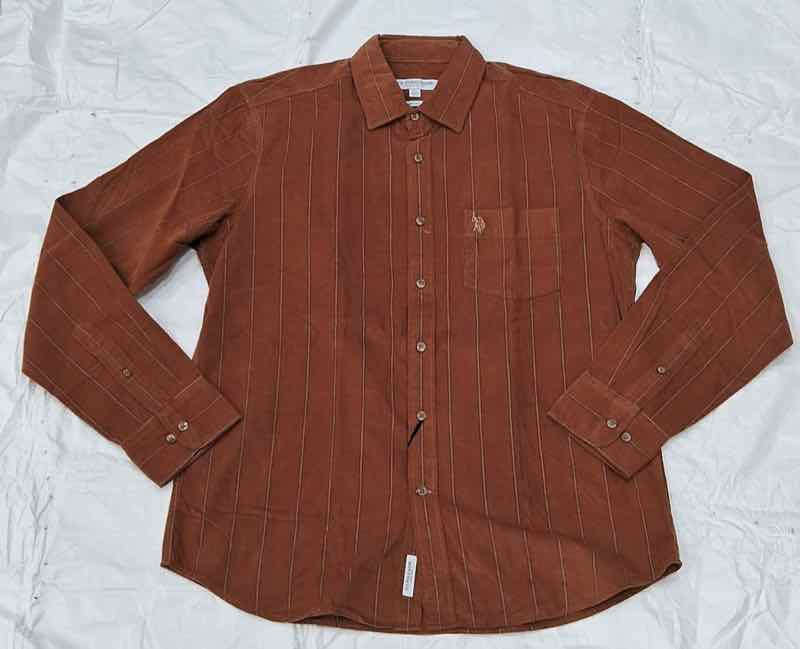
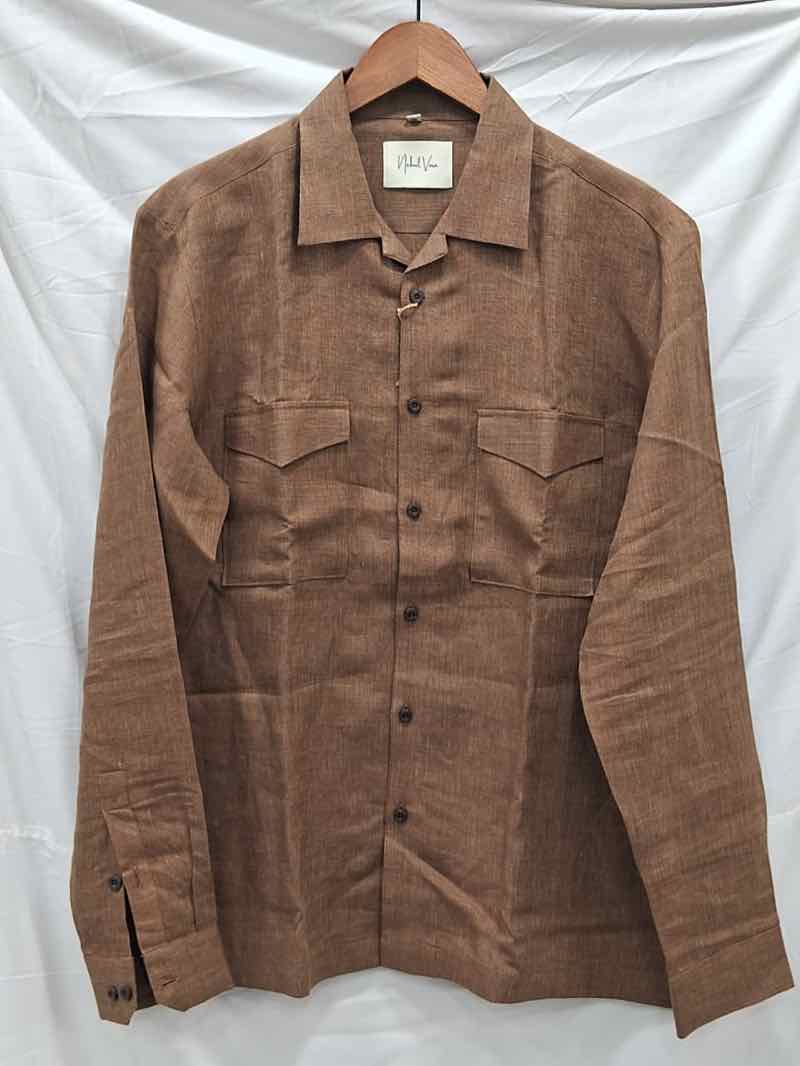
Stitching is where quality can be judged most reliably, and it can be done in a minute with nothing more than good light and a careful eye. Even on a relaxed shirt — a rust cotton shirt with a chest pocket, or a textured smart-casual shirt with a camp collar — the same principles apply. Casual does not mean careless.
Stitch density
Look along the side seams, the collar edge and the placket. Small, closely spaced stitches generally indicate a more careful build: they make seams stronger, flatter and less likely to pucker. Long, loose stitches are quicker to sew and more likely to pull or ripple. You do not need to count them; simply compare two shirts side by side and the difference is usually visible at once.
Seam finishes
Turn the shirt inside out. Side and sleeve seams on well-made shirts are commonly finished as flat-felled seams, where one edge is folded over the other and stitched down so that no raw edge is exposed. The result is clean on both faces, very durable and comfortable against the skin. An overlocked seam, with visible looped thread along a raw edge, is common on less expensive shirts and is perfectly functional, but it is bulkier and less refined.
Pattern matching
On a striped or checked shirt, look at where pieces meet: the pocket against the front, the two halves of the placket, the yoke against the sleeve. Careful makers align the pattern so that stripes continue across seams and a chest pocket almost disappears into the front. This takes more fabric and more time, which is exactly why it is a reliable sign of quality.
Placket, cuffs and buttons
The placket is the strip down the front that carries the buttons. A front placket — a raised band — is the classic business style. A French front, where the edge is simply folded under, gives a cleaner, more minimal look; a concealed placket hides the buttons altogether for evening wear. In each case, the placket should lie flat and straight from collar to hem, without twisting or rippling.
Cuffs should be firm, square and neatly finished, with a sleeve placket — the small opening above the cuff — that closes with its own button so the forearm does not show when the arm is raised. Some shirts offer two buttons on the cuff for adjustment, which is helpful if you wear a watch on one wrist.
Buttons themselves are worth a closer look. Thicker buttons with a little lustre, sometimes made from shell, feel more substantial than thin, flat plastic ones and are less likely to crack under an iron. Just as important is how they are sewn: buttons should be firmly attached with tight, neat thread, and buttonholes should be densely stitched with no loose fibres at the edges. A frayed buttonhole on a new shirt will only get worse.
A quick inspection routine
When you are looking at a shirt in person, this sequence takes less than two minutes and tells you most of what you need to know.
- Hold it up to the light and look at the collar points and edge stitching for symmetry.
- Run a finger along the collar to feel for bubbling or unevenness in the interlining.
- Turn it inside out and examine the side seams and armholes.
- Check the pattern where pocket, placket and yoke meet.
- Tug gently at a button and look at the buttonholes.
- Look at the hem — it should be narrow, even and flat, with no twisting at the side seams.
- Try it on and raise your arms; a well-built shirt should stay tucked and should not pull across the back.
Construction in the context of fit and fabric
Construction does not work alone. A beautifully sewn shirt in the wrong fit will still look wrong, and the best seams cannot rescue a fabric that is too thin for its purpose. The three elements — fit, fabric and construction — have to agree. A slim shirt needs particularly careful seams, because it is under more tension when worn. A fine poplin shows uneven stitching more readily than a textured oxford. A shirt intended for the office needs a sturdier collar than one cut for the weekend.
Our page on shirt fabrics and construction sets out the anatomy of a shirt panel by panel, and Understanding Men's Formal Shirt Fabrics explains how weave and yarn affect the way each part behaves.
The surest way to understand construction is to handle shirts yourself — to feel a collar, turn a seam and compare one cuff with another. If you would like to examine premium formal shirts in person, visit Options Mall in Juhu, Vile Parle West, and take the time to look closely at the details that make a shirt last.